ZX Spectrum / Suzy Soft / audio cassettes / 1980s

>Television
>Vuk

Author: Stevan Majstorović

About the project

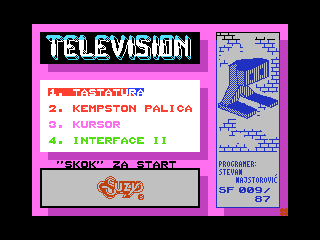
In the mid-1980s, at a time when home computers loaded software from audio cassettes, game programming was a blend of curiosity, persistence, and imagination. As a teenager, I coded games for the ZX Spectrum, trying to squeeze as much life, movement, and atmosphere as possible out of very limited hardware. Two games created in that period - Television and Vuk - were published by the then Zagreb-based publisher Suzy Soft. This site is a reflective return to that time, but also an attempt to preserve those games and make them available once again. Here you can read the story behind them, download the Z80 files for an emulator, or run them directly in a web emulator.

1986-1987.

Television

Download

I wrote Television in 1986, when I was 17 years old - exactly as old as Matthew Smith, the author of Manic Miner, who was my main role model. Matthew Smith is an absolute genius who managed to extract almost unbelievable capabilities from ZX Spectrum hardware through software, and of course I openly admit that Television is not even close to that level in any of its qualities. Still, it was born out of the same admiration for the "platform" games of that era - games in which the main character moves and jumps through levels, collects items, and tries to reach the exit.

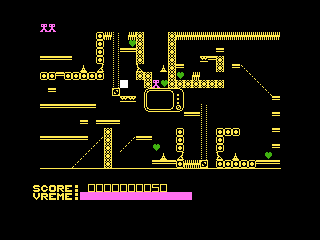
In the case of Television, the goal of each level is for the hero to collect the required items and finally switch on the television set located in the center of the screen. The game has "only" six levels, but even today they are challenging enough that I find them very hard to complete. Between the main levels there is also a bonus sequence, a small challenge of concentration and memory in which you have to notice which TV button contains the channel (this was a common analog skill of that era). It is the only button that will not be pressed, so you have to remember it and choose it.

The game was written using a combination of standard ZX Spectrum BASIC and machine code, that is, Z80 assembly. One of the details that makes it unusual (I have never seen such a use of the Z80 interrupt) is the white square, or dot, moving from left to right line by line. It was conceived as the electron beam that actually drew the image on the screen of CRT televisions at the time. In the game itself, that "beam" becomes an obstacle the player has to avoid.

What especially stayed in my memory is how the levels and graphics were created - most often first drawn on A4 squared notebook pages, during the more boring classes at the secondary electrical engineering school in Novi Sad, and only then turned into code.

For me, Television also has additional biographical value. With this game I took part in the municipal high school competition in microcomputer technology in Novi Sad in 1987 and won "only" third place. Even today it remains dear to me as a trace of a time when games were made out of pure fascination with computers, with a lot of imagination and far fewer resources than today.

1987-1988.

Vuk

Download

The game Vuk was created during 1987 and 1988 and, unlike Television, was written entirely in Z80 assembly. The sound was implemented through an interrupt routine - again inspired by solutions from Manic Miner, which also served here as a technical and creative model.

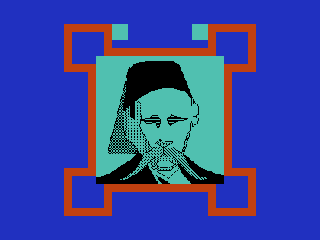
The inspiration for the game’s theme came from what many considered the best domestic television series of that period - Vuk Karadžić, which was being broadcast at that very time. That connection can be seen both in the atmosphere of the game and in its basic concept.

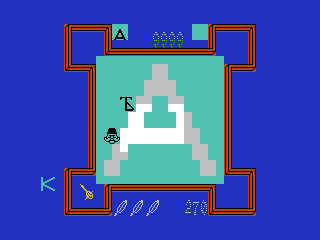
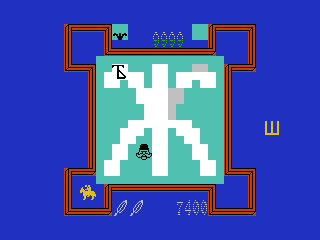
Vuk is, most likely, the only officially published game in the former Yugoslavia written entirely in Cyrillic. In the game, the player controls the character of Vuk, whose task is to trace, or color in, each Cyrillic letter - one by one, in alphabetical order. By moving through the level, segments of the letter are activated, and the goal is to complete them without colliding with obstacles.

Those obstacles, or "hindrances", were symbolically inspired by the things that also represented resistance to Vuk Karadžić himself: the crown, "sticks and stones", swords, and even the letters he removed from the alphabet. They continuously make movement more difficult and require careful planning.

Of course, there is also help that appears from time to time in the corners of the screen. Prince Marko neutralizes the hindrances, a book allows passage to the next letter, while the gusle reduce the appearance of obstacles - and every fifth gusle brings a feather. The feather is in fact the key resource in the game: instead of a classic "life", Vuk loses a feather. When he runs out of it, he can no longer draw letters, so he has to find it again on the level in order to continue.

Acknowledgments

  • Željko Horvatek, the editor of these releases at the time for Suzy Soft (Zagreb, Croatia), for his patience, understanding, and mostly postal correspondence
  • Aleksandar Martić, a bigger retro geek than me, who in 2019 converted recordings from my old audio cassettes into files, allowing me to see these teenage undertakings of mine again after some 27 years.

FROM MAGAZINES

  • "New from SUZY" Računari #39, June 1988. Announcement of the release of the games Television and Vuk.
  • "Spectrum: Planner" Moj Mikro, September 1987. - Planner (task calendar) is a lost program that was also written in assembler and sold on several tapes.
  • "Giga scroll" Svet Kompjutera #55, April 1989, source listing of a short assembler routine for scrolling (more precisely, a ticker). Interestingly, the routine was first typed on a typewriter during guard duty (fire watch) in the Yugoslav People's Army at a barracks in Niš. This ticker was used for a time by the "Snupi" video rental store in Novi Sad to announce new movie titles at the beginning of video tapes.